Collateral · Volume 1 · Locations
Teaser Ridge
A mountain settlement whose narrow strip of farmland depends on a river that no longer behaves as it once did.
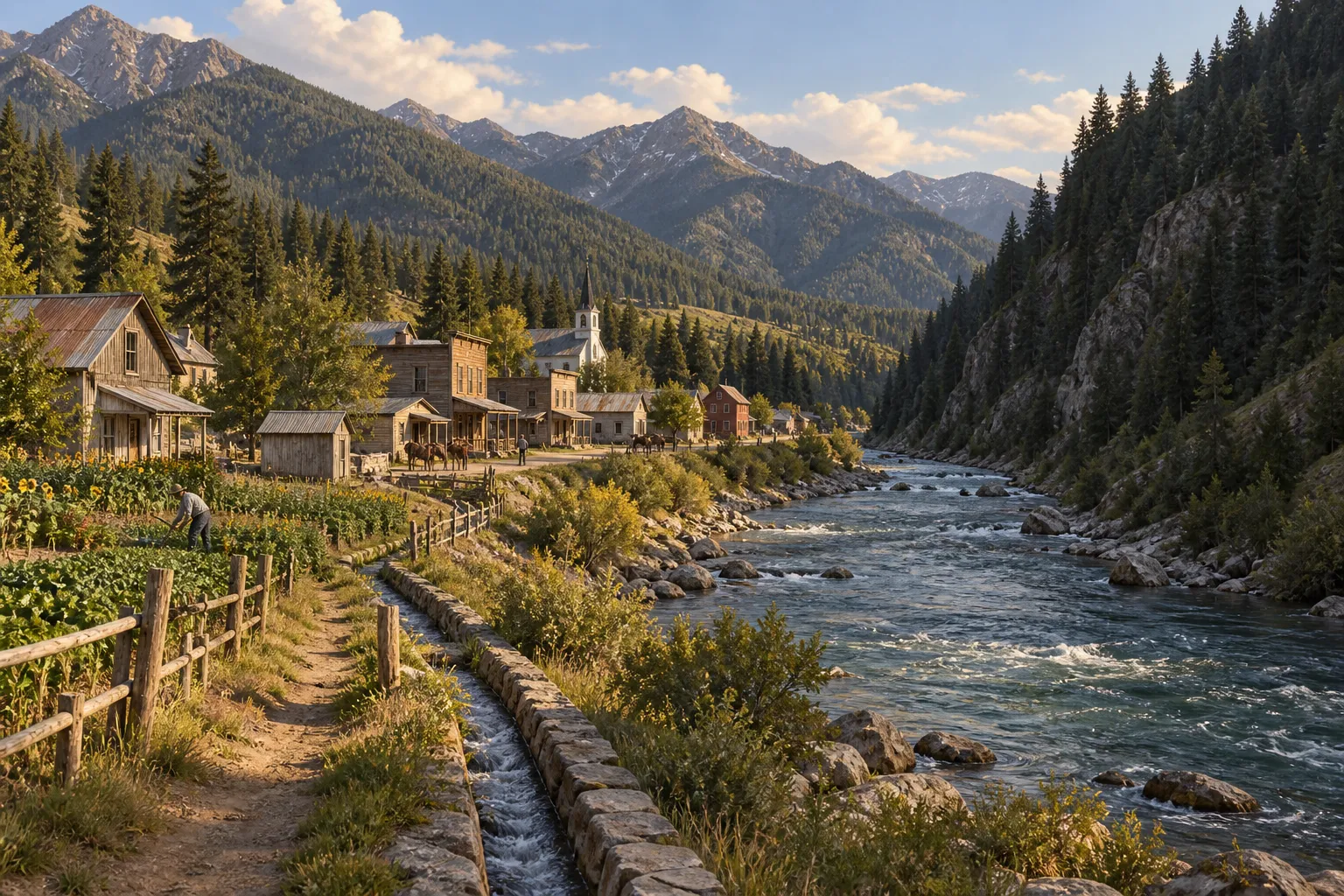
Teaser Ridge stretches along a river in a high valley beyond the eastern Rockies. One bank offers enough usable terrace for fields, a road, and a line of buildings. The other rises steeply into rock and forest. Green country surrounds the settlement, but much of that green cannot feed it.
The general store handles goods, messages, and exchanges the valley cannot do without. There is a sheriff’s office with a tiny jail, a place to drink, a church, and a one-room schoolhouse. News has little distance to travel. Neither do judgments about a stranger.
The great movement of displaced people has diminished. Empty houses and repurposed holdings remain. Most travelers still go east, toward stronger infrastructure and larger settlements. Someone coming from that direction and heading farther west is worth asking about.
The river’s timing has changed. An intake that once served the gravity-fed irrigation ditch now demands repeated repair at a poor location. High water can damage it; low water can pass beneath the mouth. The people know the trouble well. They also know the work, materials, and disruption involved in changing it.
Water access makes the narrow fields viable. A line on a property map cannot substitute for flow reaching the ground at the right time.
Its place in the storyStory discussion · Volume 1 spoilers
The travelers encounter suspicion shaped by earlier disputes over abandoned holdings, salvage, and machinery. A small town with little slack has reasons to scrutinize a man traveling with unusual robots. Those reasons can also make the jail’s cot sound surprisingly like hospitality.
The irrigation work succeeds through local knowledge and participation. Kairos can help model possibilities, but residents know what the river has done and supply hands, materials, and consent. The result belongs to the community that will maintain it.
Mebo’s intervention complicates the town’s understanding of the traveling group. He acts from a relationship of his own, rather than waiting to be classified as someone’s equipment. By the time they leave, the question of who belongs with whom has changed.
Teaser Ridge lets practical cooperation and imperfect hospitality occupy the same place. Its comedy does not make the shortage imaginary.