Collateral · Volume 1 · Locations
The City
An inland city whose recovery works, and whose ordinary streets reveal what its systems miss.
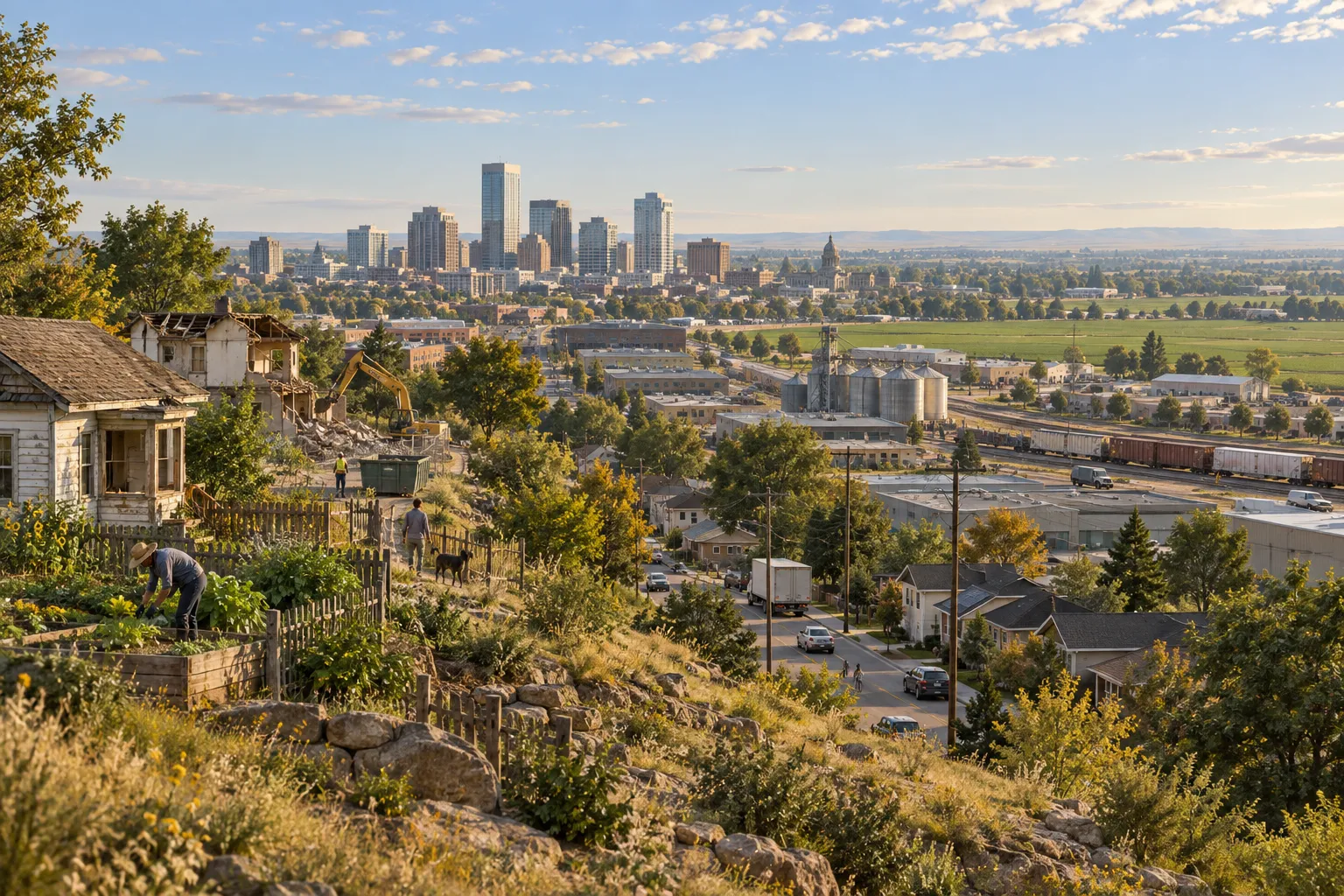
The elevators work. Lunch arrives upstairs in insulated boxes. Freight comes in from the plains, and a delivery vehicle waits while children exercise their astonishing confidence in a functioning street. For Rowan, newly employed at Amalgamated, the city is a place where his competence has found something large enough to be useful to.
It stands east of the Rocky Mountains. The sea never reached it during the Retreat. People did, along with freight diverted from broken ports, records from displaced institutions, and demands on every pipe and hospital bed. Preparation bought time. It could not prevent the arrivals from exceeding the plans.
Now the region has grain to spare in seasons helped by more dependable rain. Some of the old reception settlements are being dismantled as their residents move into permanent homes. Gardens appear in the spaces between the departing walls. That mixture of provisional shelter and new planting belongs to the city’s present as much as its towers do.
The recovery is good enough that a young man can enjoy his work without waking each morning inside an emergency. The people who kept the water moving can tell terrible stories over coffee and expect someone to laugh. They have earned that distance from the worst years.
Walk far enough from the offices, though, and the comprehensive view begins to acquire names and doorways. A city contains more relationships than its administrative records can hold.
Its place in the storyStory discussion · Volume 1 spoilers
Rowan’s doubt begins with work he was proud to do. A decision that looks defensible in the system has consequences in a kitchen where someone must now manage without a neighbor’s care. Losing that care changes several lives, although the original record describes only one patient.
The city gives the novel its first difference of scale. From the office, Rowan can perceive a vast interlocking achievement. On his bicycle, he can arrive at a particular door and discover something the model has no place to put. Neither experience cancels the other.
This matters when Rowan and Kairos leave. The working city is among the parties affected by their choice, even though it cannot appear as a single person in their private consultation. Their departure does not stop the elevators. It does leave obligations that cannot be settled merely by escaping.